
Holiday Gift Budget
How to Create a Family Holiday Gift Budget
The holidays have a funny way of getting expensive before you even realize they’ve gotten expensive.
It starts innocently enough.
A couple of gifts go in the cart. Then there are stocking stuffers. Teacher gifts. Wrapping paper. Shipping. Something for the family gift exchange you forgot about. A cute little holiday activity with the kids.
And suddenly you’re looking at your bank account wondering how Christmas managed to sneak off with that much money.
If you’ve been there, you’re definitely not alone.
Holiday spending can get out of hand quickly, especially when you’re trying to make the season feel special for everyone you love.
But creating a holiday gift budget doesn’t mean sucking all the fun out of Christmas or becoming the person counting pennies while everyone else is drinking cocoa.
It simply means deciding what you’re comfortable spending before the holiday whirlwind starts making those decisions for you.
And that can make the whole season feel a lot lighter.
In this guide, we’re going to walk through how to create a realistic holiday gift budget, figure out where your money actually needs to go, keep track of gifts without losing your mind, and stretch your budget a little further along the way.
No complicated budgeting system required.
Just a simple plan that helps you enjoy Christmas now without dreading January later.

Why a Holiday Gift Budget Helps So Much
Most of us don’t intentionally decide to overspend during the holidays.
It usually happens a few dollars at a time.
- grab one more stocking stuffer because it’s only $6.
- upgrade a gift because the nicer version is just $15 more.
- remember someone you forgot to add to your list.
Then there’s wrapping paper, cards, postage, food, travel, holiday activities, classroom parties and all those tiny purchases that somehow stop feeling tiny when you add them together.
That’s why having a holiday budget can be such a relief.
It gives you a boundary before you’re standing in Target surrounded by twinkle lights convincing yourself that everyone absolutely needs another Christmas mug.
A simple holiday budget can help you:
- Spend more intentionally instead of reacting to every sale.
- Remember the little holiday expenses that are easy to overlook.
- Feel more comfortable with what you’re spending.
- Make gift decisions based on your actual budget rather than guilt.
- Head into January without wondering what on earth happened in December.
The goal isn’t to spend as little as humanly possible.
It’s to decide what works for your family and let that be enough.
Start With Your Total Holiday Budget
Before you start assigning $25 to Aunt Linda and $10 to the Secret Santa exchange, figure out the biggest number first:
How much can you comfortably spend on the holidays altogether?
- how much you wish you could spend.
- what someone else spends.
- what social media makes Christmas look like it should cost.
What can your household reasonably afford?
Look at Your Finances as They Actually Are
Start with your regular income, bills and normal monthly expenses.
Then ask yourself:
How much money can we put toward the holidays without creating a financial mess for ourselves later?
- that number could be $200.
- it could be $500.
- or $1,000.
There isn’t one correct holiday budget.
The best number is the one that lets you celebrate without putting yourself under unnecessary financial pressure afterward.
And if this year’s budget is smaller than last year’s?
That’s okay too.
A smaller Christmas is still Christmas.
Choose Your Spending Limit
Once you know what you realistically have available, choose a firm total.
This becomes the number everything else has to fit inside.
If you aren’t sure where to start, you could experiment with setting aside a small percentage of your annual household income as a personal guideline. The original version of this plan uses roughly 1–2% as a starting point.
But treat that as a starting point, not a rule.
Your actual budget should come from what your household can comfortably afford.
Write the Number Down
This sounds almost ridiculously simple, but it matters.
Don’t keep your Christmas budget floating around somewhere in your head.
Write it down.
Once you can actually see the number, it becomes much easier to make decisions around it.
And while you’re shopping, keep track of what you’ve spent.
Otherwise a $300 budget can very easily become a $427 budget through a long series of purchases that all felt small at the time.
Want an Easier Way to Keep Track?
I created a FREE Holiday Gift Budget Planner to help you organize everything in one place.
It includes a simple budget overview, a gift tracker for keeping up with who you’re buying for, and extra ideas for saving money during the holidays.
You can print it out, keep it somewhere easy to see, and update it as you shop.
Once you know your total number, the next step is deciding where that money actually needs to go.
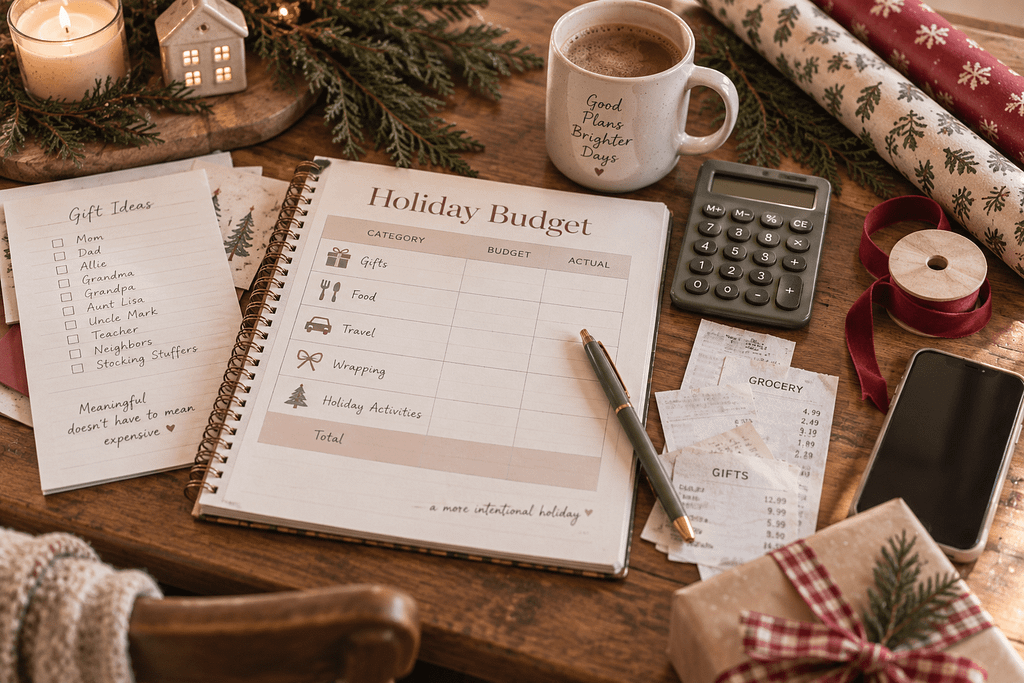
Break Your Holiday Budget Into Categories
One of the easiest holiday budgeting mistakes is thinking only about presents.
Because presents may be the obvious expense, but they are definitely not the only expense.
Think through the entire season.
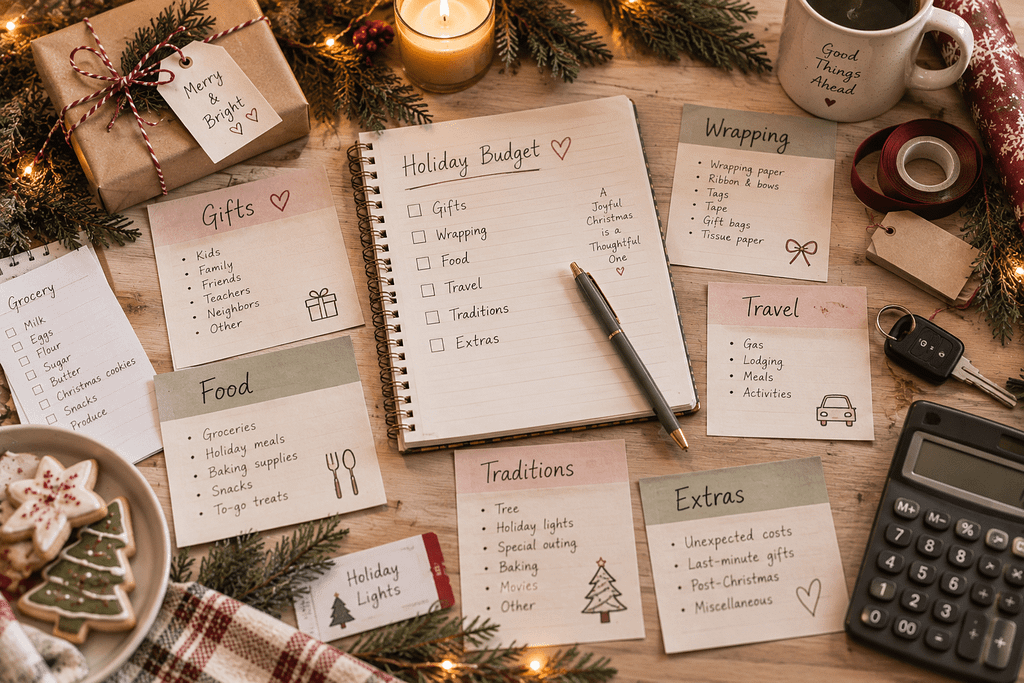
Gifts
Start with everyone you plan to buy for.
That might include your kids, partner, parents, siblings, grandparents, friends, teachers, coworkers or neighbors.
You don’t need to spend the same amount on every person.
You just need to decide ahead of time what feels reasonable.
Wrapping Paper, Gift Bags and Cards
This is one of those categories that feels insignificant until you suddenly need three rolls of wrapping paper, tape, gift tags, bows, gift bags and a pack of holiday cards.
Give these things their own little budget.
Future-you standing in the holiday aisle will appreciate it.
Food and Hosting
Holiday food can quietly take a big bite out of the budget.
If you’re hosting, think about the entire meal — not just the main dish.
Appetizers, drinks, desserts, baking ingredients and little extras count too.
And even if you aren’t hosting, you may be bringing food to parties, cookie exchanges or family gatherings.
Travel
If you’ll be traveling during the holidays, include gas, tolls, airfare, hotel stays or anything else connected to the trip.
Even relatively small travel expenses can throw off your budget if you forget to include them.
Decorations
Holiday decor is fun.
It is also extremely good at whispering, But look how cute this little tree is…*
Before buying new decorations, decide whether you actually need anything this year and give yourself a limit.
You can love Christmas without adopting another decorative reindeer.
Experiences and Traditions
Not every holiday expense comes wrapped in a bow.
Maybe your family drives around looking at Christmas lights.
Maybe you go ice skating, see a holiday show, visit Santa or have a special Christmas Eve tradition.
Those experiences deserve a place in the budget too.
The Random Stuff Category
There is almost always random stuff.
The unexpected class exchange.
Postage for a package.
Another roll of tape.
A last-minute hostess gift.
Someone announcing a White Elephant exchange three days before the party.
Give yourself a small miscellaneous cushion so every surprise expense doesn’t knock the entire budget sideways.
Once you’ve divided everything up, add those category amounts to your Holiday Gift Budget Planner.
Seeing exactly where your money is supposed to go makes the whole thing feel much more manageable.
Create Your Gift List Before You Start Shopping
Now we get to the part most of us think about first:
The gifts.
Before you start filling carts, make one master list of everyone you’re buying for.
And try to do this before you start shopping.
Because shopping first and budgeting afterward is basically how you end up saying, “Well…I guess Christmas costs $847 now.”
Give Each Person a Spending Limit
Assign a comfortable amount to each person.
You might spend more on your children or partner and less on teachers, friends or extended family.
That’s completely normal.
A price limit isn’t about putting a dollar value on the person.
It’s simply a tool for helping you decide when you’re done shopping.
Because without a stopping point, it is dangerously easy to say:
“I already bought her something, but this would be cute too…”
And then:
“Oh, this goes with it.”
Followed by the seasonal classic:
“It was on sale.”
Suddenly your $25 gift has become $72.
If the Numbers Aren’t Working, Change the Plan
Sometimes you make the list, add everything up and realize your original idea simply doesn’t fit your budget.
That doesn’t mean you failed.
It means the budget did exactly what it was supposed to do: it showed you the problem before you spent the money.
This is where you can get creative.
Suggest Secret Santa with extended family instead of everyone buying for everyone.
Split a larger gift with siblings.
Give a family gift instead of individual presents.
Plan an inexpensive experience together.
Make something.
Bake something.
Choose one meaningful gift instead of several smaller ones.
Generosity does not have to mean buying more.
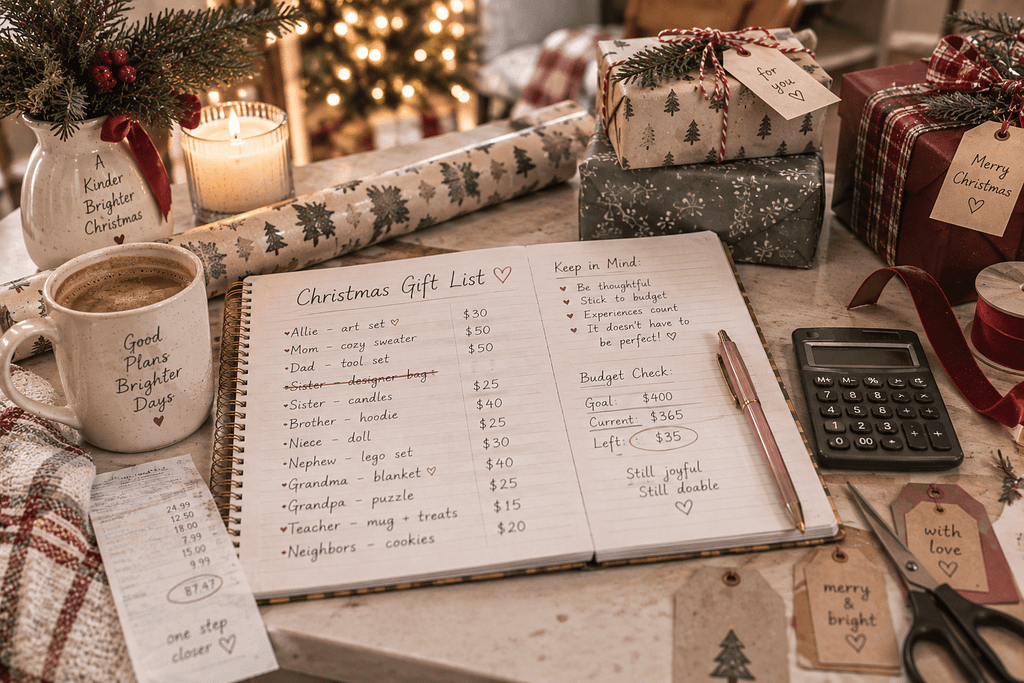
Track What You Actually Spend
Your planned amount and your actual amount probably won’t match perfectly.
That’s fine.
Maybe you budgeted $30 and found the perfect gift for $22.
Great. You just created $8 of wiggle room.
Maybe another gift ended up costing $5 more than expected.
You can adjust somewhere else.
The important thing is knowing where you stand.
That’s why I included a Gift List Tracker in the free Holiday Gift Budget Planner. You can keep track of who you’re shopping for, what you planned to spend, what you actually spent, and whether the gift has been purchased and wrapped.
Download your free Holiday Gift Budget Planner below.
How to Actually Stick to Your Holiday Budget
Making the budget while sitting calmly at the kitchen table is the easy part.
Following that budget when everything is 30% off and there’s holiday music playing?
Slightly harder.
A few simple boundaries can help.
Keep Your Budget Where You Can See It
Your holiday budget won’t help very much if you create it in November and never look at it again.
Keep your planner somewhere you’ll actually use it.
Put it on the fridge.
Keep it with your shopping list.
Save your totals in your phone.
The method doesn’t matter nearly as much as keeping the numbers visible.
Update Your Spending As You Shop
Try not to wait until the end of the week to enter everything.
Receipts disappear.
Online orders blur together.
And somehow a bunch of “little” purchases start looking suspiciously large.
Update your tracker as soon as possible after buying something.
It only takes a minute, and it gives you a much clearer picture of what you have left.
Shop From the List
Your list is there for a reason.
Before you shop, know who you’re buying for, what you hope to get them and approximately how much you can spend.
That doesn’t mean you can never change your mind.
It just keeps every cute holiday display from becoming an emergency gift situation.
Give Yourself a Cooling-Off Period
Online shopping makes impulse spending ridiculously easy.
If something wasn’t already part of your plan, leave it in the cart for a little while.
You may come back and still think it’s perfect.
Or you may look at it tomorrow and wonder why you briefly believed your sister desperately needed a heated llama-shaped foot warmer.
Holiday shopping does strange things to us.
Compare Prices When It’s Worth It
You don’t need to spend three hours trying to save 47 cents.
But for more expensive gifts, a quick price check at a couple of retailers can be worth the effort.
Shopping earlier also gives you more breathing room to wait for a better price instead of buying whatever is available three days before Christmas.
Use Rewards and Discounts You Already Have
Cashback, store rewards, digital coupons and loyalty points can help stretch your holiday budget.
Just remember:
A discount only saves you money if you were already planning to buy the thing.
Buying a $40 item you didn’t need because it was “normally $60” is still spending $40.
Holiday math can be sneaky like that.
Watch the Guilt Spending
This might be the hardest one.
Sometimes overspending has very little to do with shopping and a lot to do with emotion.
Maybe you wish you could give your kids more.
Maybe another family seems to be doing a giant Christmas.
Maybe you feel guilty setting a smaller limit for extended family.
Maybe you want the holiday to feel extra special after a hard year.
Those feelings are real.
But the amount you spend is not a measurement of how much you love someone.
A thoughtful $15 gift can be incredibly meaningful.
A handwritten note can matter.
A homemade treat can matter.
A simple family tradition can become the thing your kids remember years from now.
You do not need to prove your love through your credit card statement.
Simple Holiday Savings Ideas That Don’t Feel Miserable
Being budget-conscious doesn’t mean stripping every bit of fun out of Christmas.
Sometimes it just means doing things a little differently.
Start Earlier Than You Think You Need To
The earlier you start, the more options you have.
You can watch for discounts, compare prices, spread purchases across paychecks and avoid the dreaded last-minute I just need something shopping trip.
Even buying two or three gifts early can make December feel easier.
Use Sales Strategically
Holiday sale events can be helpful when they line up with things already on your list.
The trick is making the list before the sale.
Otherwise the sale starts making your shopping decisions for you.
And suddenly you own an air fryer, matching pajamas for everyone and a twelve-foot inflatable gingerbread man you had absolutely no intention of purchasing.
Try DIY or Semi-Homemade Gifts
Homemade gifts don’t need to be elaborate Pinterest masterpieces.
Bake cookies.
Put together a movie-night basket.
Create a hot cocoa kit.
Print a favorite family photo and put it in an inexpensive frame.
Make a simple ornament with the kids.
Sometimes personal feels much more special than expensive.
Buy Multipacks When They Actually Make Sense
Some holiday items are cheaper when purchased in larger packs, especially gift bags, bows, tissue paper and small stocking stuffers.
You can also divide certain multi-packs into several gifts.
Just make sure you genuinely need the quantity.
We are saving money here, not accidentally opening a warehouse.
Consider Family Gifts
Instead of buying several individual presents, consider one gift everyone can enjoy.
A new board game.
A family movie-night box.
A big Lego set.
A puzzle and snacks.
Tickets to an activity.
Family gifts can reduce the number of things you need to buy while still giving everyone something fun to enjoy together.
Put a Limit on Stockings
Stockings are tiny.
Their spending potential is apparently enormous.
Those $3, $5 and $8 items add up unbelievably fast.
Choose a limit for each stocking before you shop.
Once you hit it, the stocking is done.
It does not need one more thing.
I repeat: The stocking does not need one more thing.
Let Your Family’s Christmas Be Your Family’s Christmas
This one matters more than any shopping hack.
You don’t need to match someone else at Christmas.
Not your neighbor’s.
Not your sister-in-law’s.
Not the beautifully coordinated family you saw online with fourteen gifts arranged beneath a twelve-foot tree in their suspiciously spotless living room.
Your holiday can be smaller.
Simpler.
Homemade.
Secondhand.
Experience-focused.
Budget-friendly.
A little chaotic.
It can look like your actual family.
That doesn’t make it less magical.

Give Yourself a Little More Peace This Holiday Season
A holiday gift budget isn’t really about spreadsheets or tracking every last dollar.
It’s about removing some of the uncertainty.
Instead of repeatedly wondering, Can we afford this? Did I spend too much? How much have I already spent?*, you have a plan you can come back to.
And your plan doesn’t have to be perfect.
Maybe you go $10 over in one category.
Maybe something unexpected comes up.
Maybe you adjust the budget halfway through.
That doesn’t mean the whole thing is ruined.
Real-life budgeting is allowed to be flexible.
Start with what you can comfortably afford.
Decide what matters most to your family.
Write down your numbers.
Track what you spend.
And keep reminding yourself that creating a meaningful Christmas has never required buying everything.
The goal isn’t a perfect holiday.
It’s being able to enjoy the one you’re actually living without carrying a pile of financial stress into January.
And if you want a little help keeping everything organized, grab my FREE Holiday Gift Budget Planner.
It gives you one simple place to keep track of your holiday budget, gift list and spending as you go.
Download your FREE Holiday Gift Budget Planner here
Then go enjoy the cocoa, the Christmas movies, the wrapping-paper disaster and whatever slightly chaotic holiday traditions make this season feel like yours.
Because Christmas does not need to be expensive to be good. And it definitely doesn’t need to be perfect to be worth remembering.

One thought on “Create a Family Holiday Gift Budget”