

Plan Thanksgiving Dinner
Plan Thanksgiving Dinner on a Realistic Grocery Budget
There’s a particular moment that happens at the grocery store in late November.
You’re standing at the register. The belt is full of things you don’t normally buy- the heavy cream, the two kinds of broth, the bag of pecans that apparently costs nine dollars now. You’re watching the number climb and doing math you don’t want to do, and somewhere around item forty you stop looking at the screen entirely.
I’ve had that moment more than once. And the frustrating part is that it’s almost always avoidable- not by buying less food or making a sadder dinner, but by making a few decisions before you get to the store instead of in aisle six with a cart full of momentum.
So that’s what this post is. Not a list of extreme frugal hacks, and not a “feed twelve people for $20” challenge that involves three cans of cream of mushroom soup and a prayer. Just a realistic way to plan Thanksgiving dinner on a grocery budget that actually works for your family.
Thanksgiving is Thursday, November 26 this year. You’ve got time. Let’s make a plan.
Plan Thanksgiving Dinner
First, Let’s Talk About What Thanksgiving Actually Costs
It helps to have a real number to push against, so here’s the benchmark most people use.
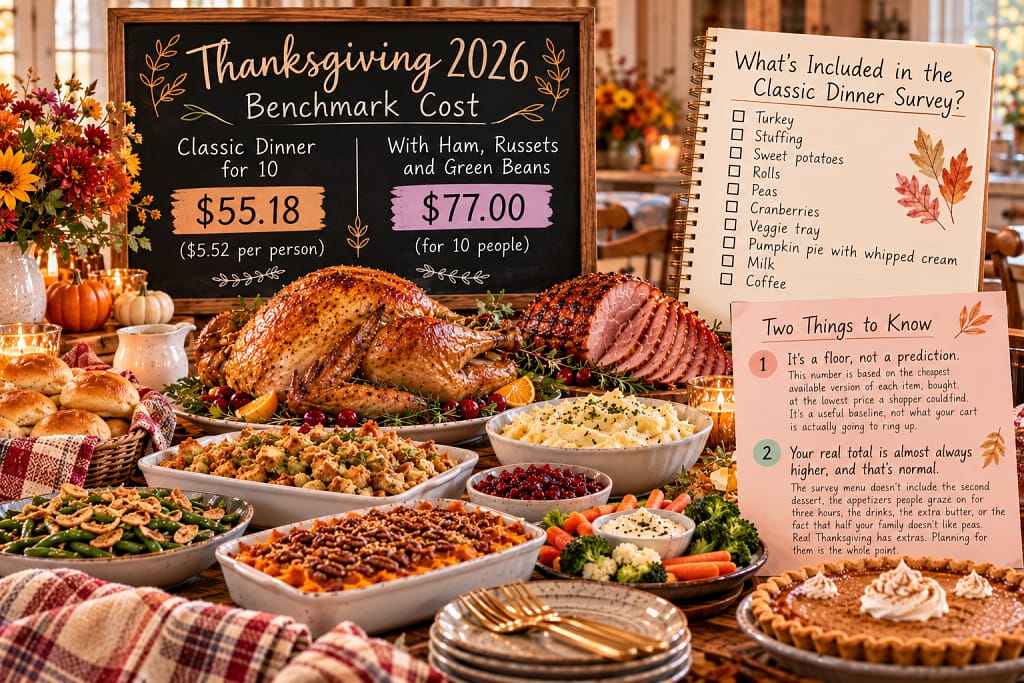
The American Farm Bureau Federation runs an annual survey of what a classic Thanksgiving dinner costs. Their 2025 survey- the most recent one, since this year’s usually lands in mid-November- put a classic dinner for 10 at $55.18, or about $5.52 per person. That’s turkey, stuffing, sweet potatoes, rolls, peas, cranberries, a veggie tray, pumpkin pie with whipped cream, and the milk and coffee to go with it.
Add ham, russet potatoes, and green beans to that same menu, and it goes up to about $77 for 10 people.
Two things to know about that number.
One: it’s a floor, not a prediction. That survey is based on the cheapest available version of each item, bought at the lowest price a shopper could find. It’s a useful baseline, not what your cart is actually going to ring up.
Two: your real total is almost always higher, and that’s normal. The survey menu doesn’t include the second dessert, the appetizers people graze on for three hours, the drinks, the butter you’ll go through, or the fact that half your family doesn’t like peas. Real Thanksgiving has extras. Planning for them is the whole point.
So for most families, a realistic range looks something like this:
| Guests | Lean but complete | Comfortable | Generous |
|---|---|---|---|
| 6 people | $50–65 | $75–95 | $110+ |
| 10 people | $70–90 | $100–135 | $160+ |
| 15 people | $95–125 | $140–185 | $220+ |
None of those columns is the “right” one. The right one is whichever matches what you actually have.
Step One: Pick Your Number Before You Pick Your Menu
This is the single thing that changes everything, and almost nobody does it.
Most of us plan Thanksgiving the other way around: decide on the menu, shop for the menu, find out what the menu cost. By then the money’s already spent and the only feeling available is the one you have at the register.
Flip it. Decide the number first.
Sit down with whatever you actually have available for this- $80, $150, whatever it is- and write it at the top of a page. That number is now a constraint you design around, the same way you’d design around the size of your oven.
Plan Thanksgiving Dinner
How to land on a number that isn’t fantasy
Ask yourself three questions:
- What did I spend last year? If you have no idea, that’s fine- most people don’t. Use the table above as a starting guess.
- Can this come out of my regular grocery budget, or does it need to be extra? Thanksgiving week usually replaces a few normal meals, so some of it isn’t new spending. But not all of it.
- Can I spread it across two or three weeks of shopping? This is the quietest, most effective trick on this whole list, and we’ll come back to it.
Write the number down. Say it out loud to whoever else lives in your house. A budget you haven’t said out loud isn’t really a budget yet.
Step Two: Do the Headcount Math
Divide your number by your headcount and you get your per-person budget. That’s your real planning tool.
$120 for 10 people is $12 a person. $120 for 15 people is $8 a person. Same budget, very different dinner, and knowing which one you’re running changes every decision after this.
A few things that affect the real headcount:
- Kids eat about half. Four kids under eight count as roughly two adults, food-wise.
- Count on leftovers. You’re not cooking one meal. You’re cooking a meal plus two or three days of lunches, and that’s a feature, not an overage. If your total feels high, divide it across all the meals it actually produces- suddenly it’s reasonable.
- Don’t cook for the crowd you’re afraid of. We all over-plan for the imaginary scenario where everyone eats triple. They don’t. They never have.
Step Three: Build the Menu Backwards From the Budget
Now you’ve got a number and a per-person figure. Build the menu to fit it, instead of hoping it fits.
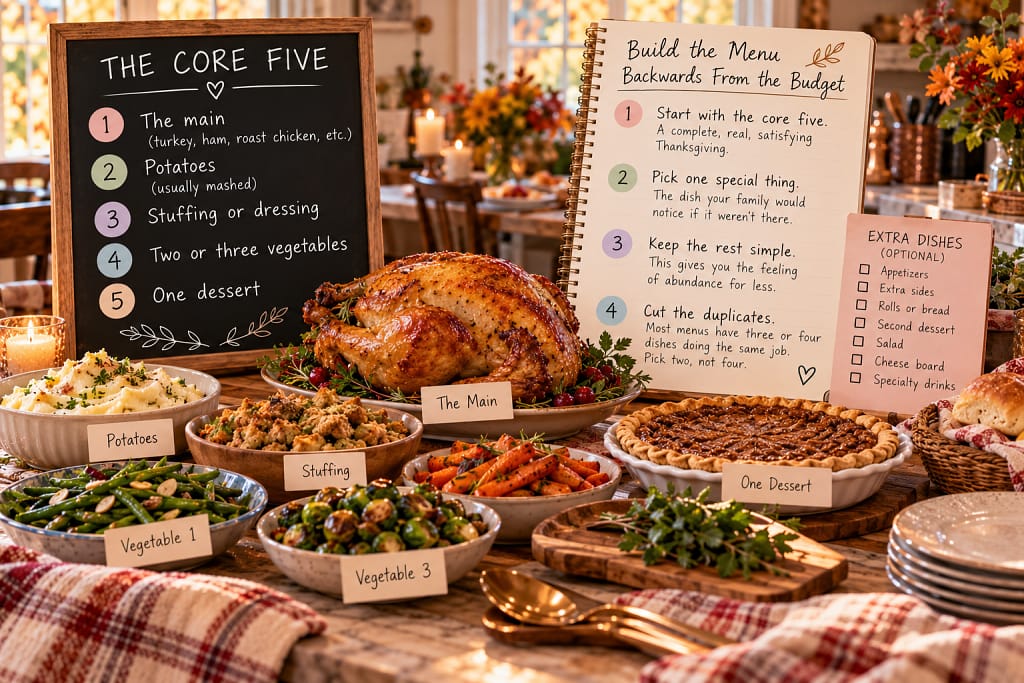
Start with the core five
Almost every Thanksgiving dinner people remember fondly has these:
- The main (turkey, or ham, or a roast chicken, or whatever your family actually likes)
- Potatoes (mashed, usually)
- Stuffing or dressing
- Two or Three vegetables
- One dessert
That’s a complete, real, satisfying Thanksgiving.
Everything past this point is optional, and I want you to sit with that for a second, because most budget overruns live in the “past this point” category.
Then apply the one-special-thing rule
Pick one dish that’s allowed to be expensive.
The thing your family would genuinely notice if it weren’t there- the pecan pie, the good cheese board, the sweet potato casserole with the real maple syrup, whatever it is in your house.
That one gets the budget it needs. Everything else gets the simple version.
This works because the feeling of abundance at a holiday meal doesn’t come from everything being fancy. It comes from one or two things being special and the rest being plentiful. You get almost all of the emotional payoff for a fraction of the cost.
Then cut the duplicates
Go through your list and look for dishes doing the same job. Most Thanksgiving menus have three or four.
- Mashed potatoes and sweet potato casserole and rolls and stuffing- that’s four starches. Two is plenty.
- Green bean casserole and roasted brussels sprouts and a salad- pick two.
- Pumpkin pie and apple pie and cookies and a trifle- if it’s a small group, one dessert and one simple extra.
Cutting duplicates is the least painful way to drop twenty or thirty dollars, because nobody notices the dish that wasn’t there. They notice the four things that were.
Plan Thanksgiving Dinner
Where the Money Actually Goes
It’s useful to know which parts of this meal are expensive and which parts are basically free, because it tells you where to spend your attention.
The turkey: 25–35% of your total
The biggest single line item, and also the easiest one to get cheaply if you plan ahead. More on this below.
Dairy and baking: more than you’d think
Butter, heavy cream, eggs, evaporated milk, cream cheese, sour cream. Individually they’re small. Together they’re frequently the second-biggest category on the receipt, and they’re the ones that sneak up on you.
The sides: genuinely cheap
Potatoes, onions, carrots, celery, canned green beans, stuffing mix, broth, frozen corn. The actual side dishes of Thanksgiving are built from some of the least expensive food in the grocery store. This is where you can be generous without consequence.
The extras: where budgets go to die
Appetizers, drinks, specialty cheeses, fresh herbs, pecans and walnuts, the second dessert, disposable serving dishes, the “oh I should grab something for the kids” cart additions.
I’m not telling you to skip all of these. I’m telling you to decide on them in advance rather than in the store, because every single one of them is a decision made under mild holiday pressure.
How to Buy the Turkey Without Overpaying
The turkey is the one item where timing matters more than anything else you do.
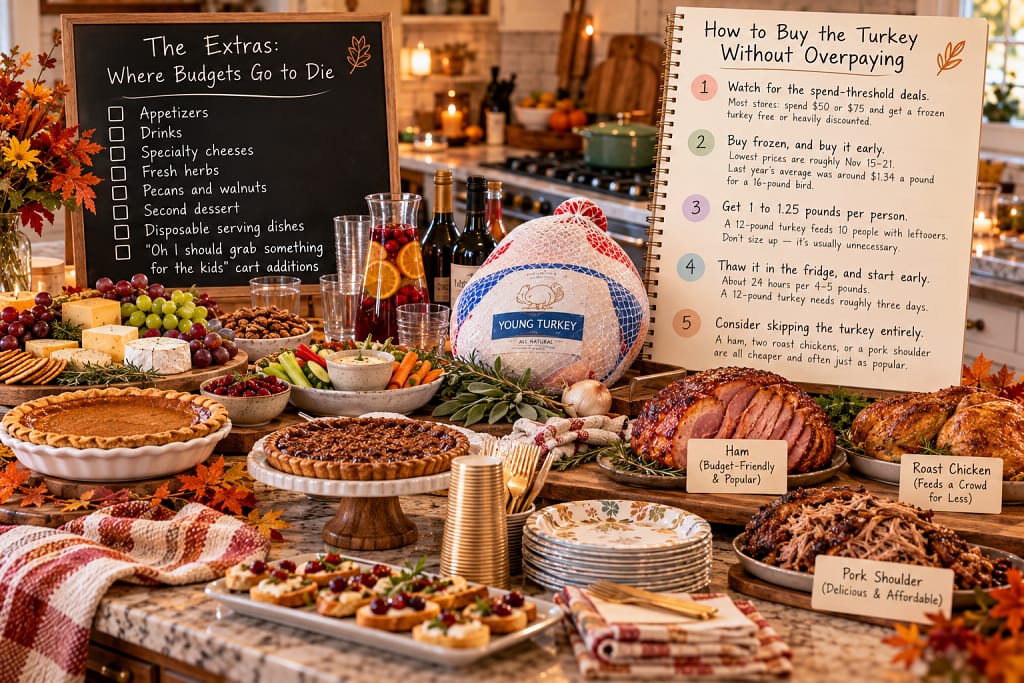
Watch for the spend-threshold deals. Most grocery stores run a promotion in the two weeks before Thanksgiving: spend $50 or $75 and get a frozen turkey free or heavily discounted. If you’re already buying groceries that week anyway, this is the cheapest turkey you will ever get. Plan your regular shopping trip around it.
Buy frozen, and buy it early. Frozen turkeys hit their lowest prices roughly the week of November 15–21, and they keep in the freezer for months. Last year’s average was around $1.34 a pound for a 16-pound bird. If you see anything near or under that, take it.
Get 1 to 1.25 pounds per person. A 12-pound turkey feeds 10 people with leftovers. The urge to size up is strong and almost always unnecessary — and a bigger bird costs more, takes longer, and gives you more leftovers than you’ll realistically eat before you’re tired of them.
Thaw it in the fridge, and start early. About 24 hours per 4–5 pounds. A 12-pound turkey needs roughly three days. Set a phone reminder now, because a still-frozen turkey on Thanksgiving morning is the one mistake on this list that actually costs you money — that’s when people end up buying an emergency second main.
Consider skipping the turkey entirely. If your family doesn’t love turkey- and plenty of families don’t, they just make it out of obligation- a bone-in ham, two roast chickens, or a pork shoulder are all cheaper and often more popular. Nobody has ever been sad about a Thanksgiving with good food on it.
Spread the Shopping Across Three Trips
This is the technique that makes a Thanksgiving budget feel survivable instead of brutal, and it costs nothing to use.
Instead of one enormous $140 trip the weekend before, split it:
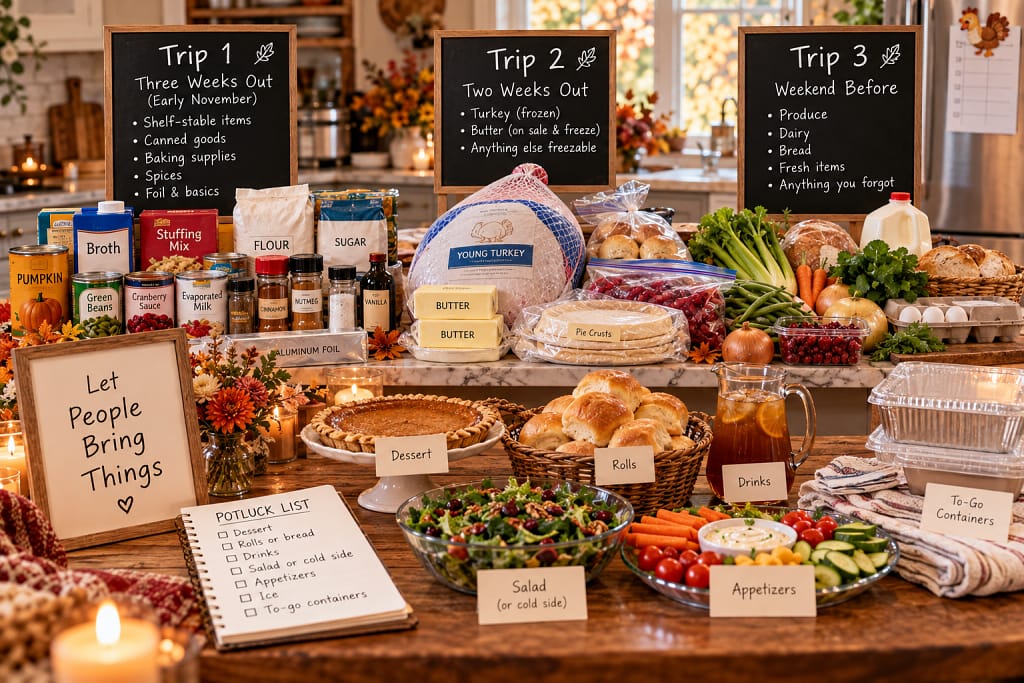
Trip 1 — three weeks out (early November). All the shelf-stable things. Canned pumpkin, broth, stuffing mix, canned vegetables, flour, sugar, spices, foil, evaporated milk. These never go bad before the holiday and they’re often on seasonal sale this early.
Trip 2 — two weeks out. The turkey (frozen, into the freezer), butter (it freezes beautifully — buy it when it’s on sale and stack it), and anything else freezable.
Trip 3 — the weekend before. Produce, dairy, bread, and whatever you forgot.
Same total, three smaller numbers. It fits inside your normal weekly grocery spending instead of landing as one giant hit, which matters enormously when money is tight. It also means you’re buying each category when it’s cheapest rather than all at once at full price.
Plan Thanksgiving Dinner
Let People Bring Things
I want to address this directly, because it’s the biggest unused lever most hosts have and it’s almost always guilt that stops us from pulling it.
Letting people contribute to Thanksgiving is not a failure of hosting. It is, in most families, what people actively want to do. The question “what can I bring?” is usually sincere.
The trick is to answer it specifically.
“Oh, nothing, just yourself” gets you nothing. “Could you bring a dessert?” gets you a dessert. “Could you bring the rolls and a bottle of something?” gets you exactly that, and takes two items off your list.
Some assignments that work well because they travel and don’t need oven space:
- Dessert (the single most helpful thing to hand off- it’s often the most expensive and most time-consuming item)
- Rolls or bread
- Drinks, including anything for the kids
- A salad or a cold vegetable side
- Appetizers
- Ice, and the disposable containers for sending leftovers home
If you’re hosting, you’re already covering the turkey, the oven, the house, the cleanup, and the two days of prep. Handing out four items is not asking too much. It’s a reasonable division of labor among adults.

Shop Your Kitchen First
Before you write a single thing on the grocery list, go stand in front of your own pantry with the list in your hand.
You almost certainly already own: flour, sugar, brown sugar, cinnamon, nutmeg, vanilla, salt, pepper, oil, some kind of broth or bouillon, probably a can or two of something.
Every one of those you don’t re-buy is money that stays in the budget for the thing you actually care about.
Check specifically for:
- Spices. This is where it hurts most — a jar of poultry seasoning or nutmeg can be $5–7, and there’s often one already in the back of the cabinet from last year. Spices lose potency but don’t spoil.
- Baking staples. Flour, sugar, baking powder.
- Canned goods. Broth, pumpkin, evaporated milk, green beans.
- The freezer. Butter, bread, pie crust, stock, anything you stashed.
Write down what you have before you write down what you need. It’s ten minutes and it routinely saves fifteen or twenty dollars.
Plan Thanksgiving Dinner
Swaps That Save Real Money and Nobody Notices
Not all cost-cutting is equal.
These are the ones where the finished dish is genuinely just as good.
| Instead of | Use | Roughly saves |
|---|---|---|
| Boxed chicken broth | Bouillon + water, or stock from the turkey neck and giblets | $4–8 |
| Fresh green beans | Frozen or canned green beans | $3–5 |
| Store-bought pie | Homemade with a refrigerated crust | $6–10 |
| Pecans and walnuts in everything | One dish with nuts, not three | $8–15 |
| Heavy cream for mashed potatoes | Whole milk + extra butter | $3–4 |
| Fresh herbs | Dried, at about a third of the amount | $6–12 |
| Name-brand everything | Store brand on canned goods, baking staples, dairy | $10–20 across a full cart |
| A veggie tray from the deli | Carrots, celery, and ranch you assemble yourself | $8–12 |
And one that isn’t on the table because it’s worth saying plainly: refrigerated pie crust is completely fine. Homemade crust is lovely if you enjoy making it. If you don’t, a $3 crust in a dish you blind-baked yourself is a homemade pie, I said what I said.
What a Real Thanksgiving Budget Looks Like
Two sample plans for 10 people, to make this concrete. Prices are approximate and will vary by where you shop.
The $75 Thanksgiving
| Item | Cost |
|---|---|
| 12 lb frozen turkey (sale or store promo) | $12–16 |
| Potatoes (5 lb bag) | $4 |
| Stuffing mix (2 boxes) + broth | $5 |
| Frozen green beans + canned corn | $5 |
| Sweet potatoes + brown sugar | $6 |
| Rolls | $4 |
| Cranberry sauce | $2 |
| Butter, milk, eggs, cream | $14 |
| Pumpkin pie (homemade, refrigerated crust) | $7 |
| Onions, celery, carrots, seasonings | $6 |
| Drinks | $5 |
| Total | ~$72 |
Plan Thanksgiving Dinner
The $130 Thanksgiving
Everything above, plus:
| Addition | Cost |
|---|---|
| A larger or fresh turkey, or adding a small ham | +$18 |
| A real appetizer spread (cheese, crackers, fruit) | +$15 |
| Second dessert | +$10 |
| The one-special-thing dish done properly | +$12 |
| Better rolls, real cream, nicer coffee | +$10 |
| Total | ~$137 |
Both of these are a good Thanksgiving. The second one isn’t better, it’s just bigger. Worth remembering while you’re deciding.
Count the Leftovers as Part of the Value
Here’s a re-frame that makes the number easier to look at.
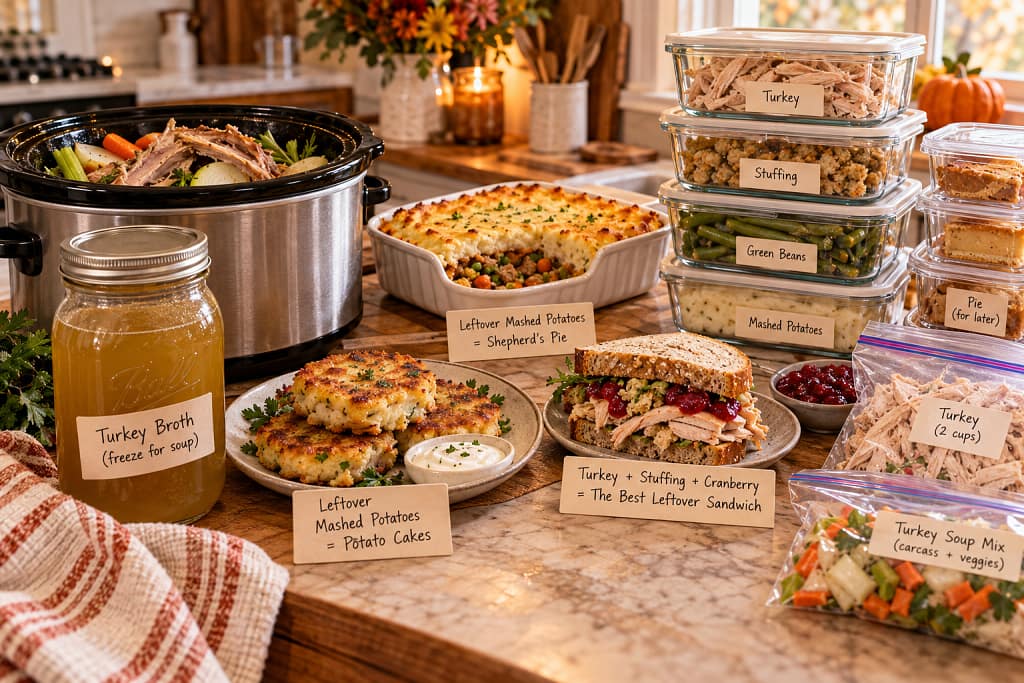
You’re not spending $120 on one meal. You’re spending $120 on dinner for ten people plus roughly three days of leftover lunches, a turkey carcass that becomes a pot of soup, and a few meals you now don’t have to plan at all during a week when you have no capacity to plan anything.
Spread across what it actually produces, Thanksgiving is often one of the cheaper meals of the month on a per-serving basis. That doesn’t make it easier to pay for in one week, but it does make it a different kind of expense than it looks like at the register.
Plan for the leftovers on purpose:
- Turkey carcass into the slow cooker overnight with some water, the onion ends, celery, and carrot peels. That’s free broth for a month of soup.
- Leftover mashed potatoes into potato cakes, or as the topping on a shepherd’s pie.
- Turkey, stuffing, and cranberry into sandwiches- which is, for a lot of us, the actual best meal of the week.
- Freeze what you won’t eat by Sunday in single portions. A frozen portion gets eaten. A giant container of turkey does not.
If the Number Is Still Too High
Sometimes you do all of this and the math still doesn’t work.
That happens, and it doesn’t mean you planned badly.
A few honest options:
Make it a potluck for real. Not “bring a side if you want”- an actual assigned-dish potluck where you provide the turkey and the house and everyone else brings one thing. This is a completely normal way for families to do a holiday.
Shrink the guest list this year. A quiet Thanksgiving for four is allowed. It’s also, some years, genuinely the better choice.
Change the main. Two roast chickens or a pork shoulder will cost half what a turkey does and feed the same number of people.
Skip the appetizers entirely. People are about to eat an enormous meal. The three hours of grazing beforehand is tradition, not necessity, and it’s frequently 20% of the grocery bill.
Let it be simple. A small table with good mashed potatoes, a main, one vegetable, and a pie is a real Thanksgiving. The year you remember won’t be decided by how many side dishes were on the table.

Start With the Number, Not the Menu
If you take one thing from all of this, make it that.
Decide what you can spend. Divide it by the people coming. Build a menu that fits, pick one thing to splurge on, let people bring the rest, and spread the shopping across three weeks so it never lands as one number you don’t want to look at.
That’s the whole system. It takes about twenty minutes at the kitchen table with a pen, and it’s the difference between walking into the store with a plan and walking in with a vague sense of dread.
Your family isn’t going to remember what the receipt said. They’re going to remember whether you were present at the table or stressed out in the kitchen doing math.
Pick your number this week. Then go enjoy your people.
Want help getting your regular grocery spending under control, not just the holiday? I built a whole course on it inside The Unscripted Mom Collective called The Real-Life Grocery Budget — it’s built around the idea that value is bigger than price.
Plan Thanksgiving Dinner
FAQ
- How much should I budget for Thanksgiving dinner? Plan for roughly $7–13 per person depending on how generous you want the table to be. For 10 people that’s about $70 on the lean end and $135 for a comfortable spread with appetizers and a second dessert. The Farm Bureau’s 2025 benchmark for a classic dinner for 10 was $55.18, but that figure uses the lowest available price for every item and doesn’t include drinks, appetizers, or extras- so treat it as a floor rather than a forecast.
- When is the cheapest time to buy a Thanksgiving turkey? Frozen turkeys typically hit their lowest prices the week of November 15–21, and many stores run spend-threshold promotions ($50 or $75 spent) that make the bird free or close to it. Buy frozen and early, then keep it in the freezer- it holds for months and thaws in about 24 hours per 4–5 pounds.
- How do I make Thanksgiving cheaper without it feeling cheap? Cut duplicate dishes rather than cutting quality. Most menus have three or four starches and three desserts doing the same job. Keep one dish that’s allowed to be expensive, make everything else the simple version, and be generous with the genuinely cheap foods- potatoes, onions, carrots, stuffing, frozen vegetables. Abundance comes from plenty, not from everything being fancy.
- Is it rude to ask guests to bring food to Thanksgiving? No- and most guests would rather be given a specific assignment than told “just bring yourself.” If you’re providing the turkey, the oven, the house, and two days of prep, asking four people to bring dessert, rolls, drinks, and a salad is a reasonable division of labor. Be specific; vague requests get vague results.
- How can I afford Thanksgiving if money is tight this year? Spread the shopping across three trips in November so the cost lands inside your normal weekly grocery spending instead of as one large hit. Swap the turkey for two roast chickens or a pork shoulder. Skip appetizers entirely- people are about to eat an enormous meal. And consider a real assigned-dish potluck, which is a completely normal way for families to do the holiday.
Sources for the cost figures: American Farm Bureau Federation 2025 Thanksgiving survey, via Feedstuffs · Cheaper turkeys help bring down Thanksgiving dinner costs, WRAL

